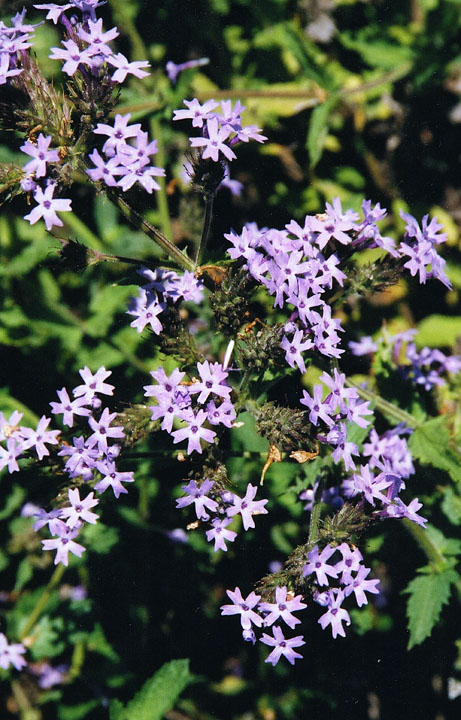
Overview
Verbena hastata is a upright, trailing perennial herbaceous in the genus Verbena, part of the Verbenaceae family, with deciduous foliage. It typically grows around 1.5 m tall. Verbena hastata grows best in full sun, and tolerates most soils and neutral pH. Its UK hardiness is rated H7. Suggested uses include wildlife gardens, naturalized areas and rain gardens. It is native to N America.
About
Verbena hastata is a perennial herbaceous in the Verbenaceae that produces tall, narrow flowering spikes reaching about 1.5 m. The flowers are violet to deep purple, occasionally white, and appear in succession. It prefers a sunny position and soils that remain moist but are well drained. Fully hardy in the UK, it flowers from June to October.
Wikipedia contributors, CC BY-SA 4.0 — Verbena hastata
About the genus
Verbena, also known as vervain or verveine, is a genus in the family Verbenaceae. It contains about 150 species of annual and perennial herbaceous or semi-woody flowering plants. The majority of the species are native to the Americas and Asia; however, Verbena officinalis, the common vervain or common verbena, is the type species and native to Europe.
Wikipedia contributors, "Verbena", CC BY-SA 4.0 — Verbena
In the garden
Verbena hastata (American blue vervain) is a perennial herbaceous member of the Verbenaceae, native to North America. Plants grow to roughly 1.5 m with upright flowering spikes of violet to deep purple (rarely white) blooms; flowering runs from June to October in the UK. Give it full sun and soil that stays moist but drains—sandy, loamy or clay soils are all acceptable provided they do not become waterlogged. It is rated H7 for UK hardiness (fully hardy) and corresponds to roughly USDA zones 3–7, so established crowns tolerate winter cold without protection. Use Verbena hastata in wildlife gardens, naturalised borders or rain-garden situations where moisture is present through the growing season. Plants sit well toward the middle or rear of a planting where their vertical spikes can rise above lower perennials. Expect extended, sequential flowering from June to October that provides sustained summer-to-autumn presence in damp or reliably moist spots.
Growing conditions
Best soil and position for Verbena
- Sunlight
- Full sun
- Soil type
- Sandy, Loamy, Clay
- Soil pH
- Neutral
- Soil moisture
- Moist but well-drained
- Aspect
- South-facing
- Exposure
- full sun
- UK hardiness
- H7
Plant details
Verbena hastata size, habit and characteristics
- Plant type
- perennial herbaceous
- Habit
- Upright, Trailing
- Foliage
- Deciduous
- Height
- 1.5 m
- Suggested uses
- wildlife gardens, naturalized areas, rain gardens
- Native to
- N America
Care notes
Pruning and caring for Verbena hastata
- Cultivation
- Prefers moist, fertile soil; tolerates wet conditions; avoid drought stress
- Pruning
- Cut back in early spring to encourage fresh growth
- Propagation
- seed, division
- Pest resistance
- Generally pest-free
- Disease resistance
- Generally disease-free
Frequently asked questions
How do I grow Verbena hastata?
Prefers moist, fertile soil; tolerates wet conditions; avoid drought stress.
Where is the best place to plant Verbena hastata?
Verbena hastata prefers full sun. It suits full sun positions.
What soil does Verbena hastata need?
Verbena hastata is adaptable and grows happily in most soil types, including sandy, loamy and clay. It prefers neutral soil. Aim for soil that stays moist but well-drained.
How do I prune Verbena hastata?
Cut back in early spring to encourage fresh growth.
How big does Verbena hastata grow?
Verbena hastata reaches a height of 1.5 m.
Is Verbena hastata hardy in the UK?
Verbena hastata has an RHS hardiness rating of H7, meaning it is fully hardy throughout the UK, tolerating temperatures below -20°C.
How do I propagate Verbena hastata?
Seed, division.