Overview
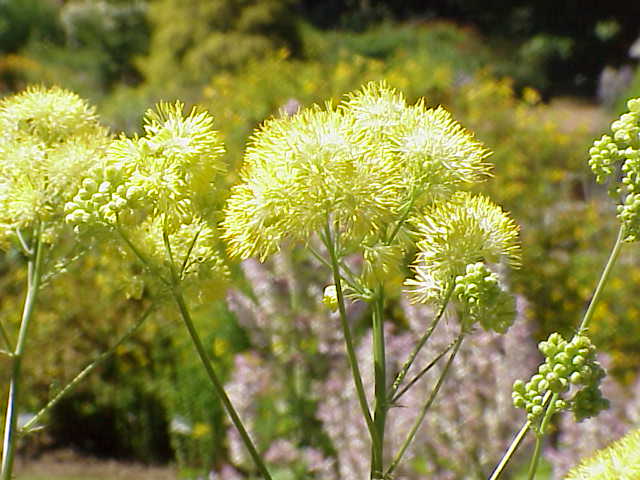
Thalictrum diffusiflorum is a perennial in the genus Thalictrum, part of the Ranunculaceae family. Thalictrum diffusiflorum grows best in partial shade and full sun, and tolerates well-drained and loamy soils and neutral and slightly acidic pH. Suggested uses include borders, woodland gardens and naturalistic plantings. It is native to SW China.
About
Thalictrum diffusiflorum is a perennial in the Ranunculaceae, native to south-west China and commonly called diffuse-flowered meadow rue. It flowers from June to August. It prefers partial shade to full sun on moist, well-drained loamy soil with a neutral to slightly acidic pH. Contact with the foliage may irritate the skin, so wear gloves when handling.
About the genus
Thalictrum is a genus of 120–200 species of herbaceous perennial flowering plants in the buttercup family, Ranunculaceae, native mostly to temperate regions. Meadow-rue is a common name for plants in this genus.
Wikipedia contributors, "Thalictrum", CC BY-SA 4.0 — Thalictrum
In the garden
Thalictrum diffusiflorum is a perennial member of the Ranunculaceae from south-west China, traded as diffuse-flowered meadow rue. It comes into flower in the UK between June and August, offering a mid-summer display suited to cooler, damper sites rather than dry, exposed banks. Plant in partial shade or full sun on a well-drained, loamy soil that remains moist and leans neutral to slightly acidic in pH. North-, east- or west-facing positions are appropriate, and the species prefers sheltered to semi-exposed exposures rather than fully exposed sites. Work organic matter into the planting hole to improve moisture retention without creating waterlogging; the combination of good drainage and consistent moisture is important for reliable growth. Use Thalictrum diffusiflorum in mixed borders, woodland gardens or naturalistic plantings where a summer-flowering perennial is required. It sits well where other moisture-tolerant perennials provide structure and can take sun if the soil does not dry out. Handle with care: contact with the foliage may irritate the skin, so wear gloves and other protective equipment during planting and maintenance.
Growing conditions
Best soil and position for Thalictrum
- Sunlight
- partial shade, full sun
- Soil type
- well-drained, loamy
- Soil pH
- neutral, slightly acidic
- Soil moisture
- moist
- Aspect
- north, east, west
- Exposure
- sheltered to semi-exposed
Plant details
Thalictrum diffusiflorum size, habit and characteristics
- Plant type
- perennial
- Suggested uses
- borders, woodland gardens, naturalistic plantings
- Native to
- SW China
- Toxicity
- Contact with foliage may irritate the skin. Wear gloves and other protective equipment when handling
Care notes
Pruning and caring for Thalictrum diffusiflorum
- Cultivation
- Prefers moist, well-drained soil in partial shade; avoid waterlogged conditions.
- Pruning
- Cut back to ground level after flowering to encourage fresh growth.
- Propagation
- Seed, division in spring
Frequently asked questions
How do I grow Thalictrum diffusiflorum?
Prefers moist, well-drained soil in partial shade; avoid waterlogged conditions.
Where is the best place to plant Thalictrum diffusiflorum?
Thalictrum diffusiflorum prefers partial shade and full sun. It suits sheltered to semi-exposed positions.
What soil does Thalictrum diffusiflorum need?
Thalictrum diffusiflorum grows best in well-drained and loamy soil. It prefers neutral and slightly acidic soil. Aim for soil that stays moist.
How do I prune Thalictrum diffusiflorum?
Cut back to ground level after flowering to encourage fresh growth.
How do I propagate Thalictrum diffusiflorum?
Seed, division in spring.
Is Thalictrum diffusiflorum toxic?
Contact with foliage may irritate the skin. Wear gloves and other protective equipment when handling.
More in the Thalictrum genus
- Thalictrummeadow rue
- Thalictrum 'Black Stockings'Meadow-rue
- Thalictrum 'Nimbus Pink'Meadow-rue
- Thalictrum Chantilly Lace ('Mactha002')Meadow-rue
- Thalictrum del. 'Splendide White'Meadow-rue
- Thalictrum del. 'Splendide'Meadow-rue
- Thalictrum delavyi 'Hinkley'Meadow-rue
- Thalictrum roch. var. grandMeadow-Rue