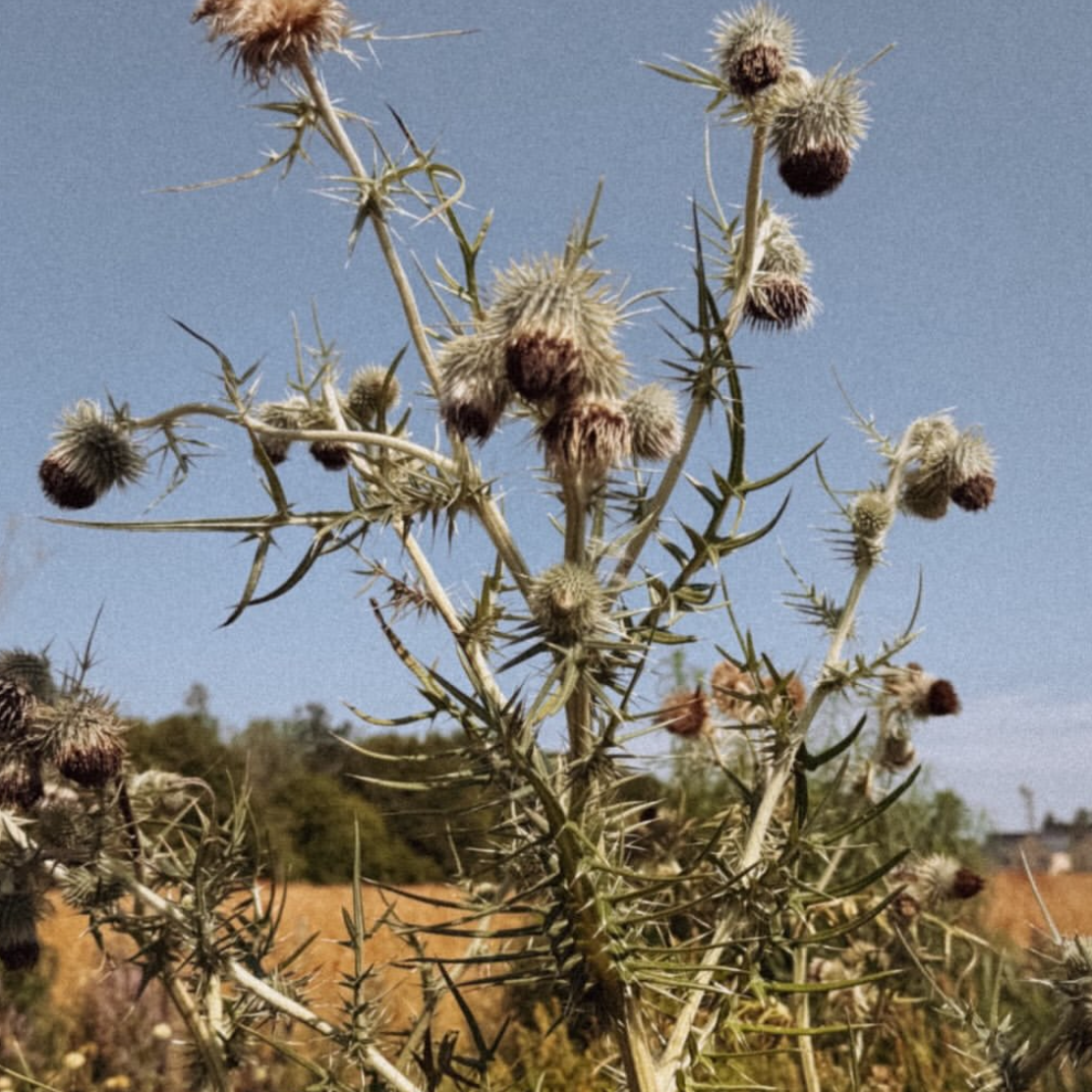
Overview
Cirsium eriophorum is a biennial herbaceous in the genus Cirsium, part of the Asteraceae family. It typically grows around 1.5 m tall. Cirsium eriophorum grows best in full sun, and tolerates most soils. Its UK hardiness is rated H7. It is native to Liechtenstein, Romania, Austria, Belgium, Czechoslovakia, Czech Republic, Macedonia and Slovenia.
About
Cirsium eriophorum is a biennial herbaceous thistle in the family Asteraceae, commonly called woolly thistle. It typically reaches about 1.5 m at maturity. It prefers full sun and performs in moist but well-drained sandy, loamy or clay soils. It is fully hardy in the UK (H7).
Wikipedia contributors, CC BY-SA 4.0 — Cirsium eriophorum
About the genus
Cirsium is a genus of perennial and biennial flowering plants in the Asteraceae, one of several genera known commonly as thistles. They are more precisely known as plume thistles. These differ from other thistle genera in having a seed with a pappus of feathered hairs on their achenes.
Wikipedia contributors, "Cirsium", CC BY-SA 4.0 — Cirsium
In the garden
Cirsium eriophorum is a biennial herbaceous plant native to parts of central and eastern Europe, including Liechtenstein, Romania, Austria, Belgium, the Czech lands, Macedonia and Slovenia. As a biennial it develops vegetatively in the first year and produces flowering stems in its second year, reaching around 1.5 m at peak growth. Flowering occurs July to September. Plant in a sunny, open position; the species favours full sun and tolerates a range of soil textures from sandy through loamy to clay provided the site is moist but well drained. The hardiness rating H7 denotes fully hardy in UK gardens, and the equivalent USDA range is 5–9, so established plants survive typical winter conditions across most British regions. Use Cirsium eriophorum where space allows for tall second-year stems — suitable places include the rear of large herbaceous borders, naturalised meadow patches or sunny margins. Leave room for its mature height when siting and ensure the soil drains freely to avoid waterlogging. Expect flowering stems to reach about 1.5 m and to be in bloom between July and September.
Growing conditions
Best soil and position for Cirsium
- Sunlight
- Full sun
- Soil type
- Sandy, Loamy, Clay
- Soil moisture
- Moist but well-drained
- Exposure
- full sun
- UK hardiness
- H7
Plant details
Cirsium eriophorum size, habit and characteristics
- Plant type
- biennial herbaceous
- Height
- 1.5 m
- Native to
- Liechtenstein, Romania, Austria, Belgium, Czechoslovakia, Czech Republic, Macedonia, Slovenia
Care notes
Pruning and caring for Cirsium eriophorum
- Cultivation
- Prefers well-drained soils; avoid waterlogged conditions; tolerates poor soils
- Pruning
- Remove spent flower heads to prevent self-seeding
- Propagation
- By seed sown in situ in autumn or spring
Frequently asked questions
How do I grow Cirsium eriophorum?
Prefers well-drained soils; avoid waterlogged conditions; tolerates poor soils.
Where is the best place to plant Cirsium eriophorum?
Cirsium eriophorum prefers full sun. It suits full sun positions.
What soil does Cirsium eriophorum need?
Cirsium eriophorum is adaptable and grows happily in most soil types, including sandy, loamy and clay. Aim for soil that stays moist but well-drained.
How do I prune Cirsium eriophorum?
Remove spent flower heads to prevent self-seeding.
How big does Cirsium eriophorum grow?
Cirsium eriophorum reaches a height of 1.5 m.
Is Cirsium eriophorum hardy in the UK?
Cirsium eriophorum has an RHS hardiness rating of H7, meaning it is fully hardy throughout the UK, tolerating temperatures below -20°C.
How do I propagate Cirsium eriophorum?
By seed sown in situ in autumn or spring.